They search, you are not there
Someone two miles away types "brake repair near me". If your Google profile is thin or your site is five years old, they call the shop on the next block instead. Nothing else on this page matters more.
Services
Website designLocal SEOGoogle Business ProfileReview managementMissed-call text-backCRM & follow-upSocial & chat automationAI & automationIndustries
Auto repair shopsHVAC contractorsPlumbersElectriciansDental practicesLandscapersLocations
Riverside County TemeculaMurrietaMenifeeWildomarLake ElsinoreHemetPerrisCanyon LakeWinchesterFrench ValleyMore
PricingContactA site that takes appointments straight into your calendar, a Google profile that actually brings people in, reviews that keep coming, and follow-up that fills the bays you were going to leave empty.
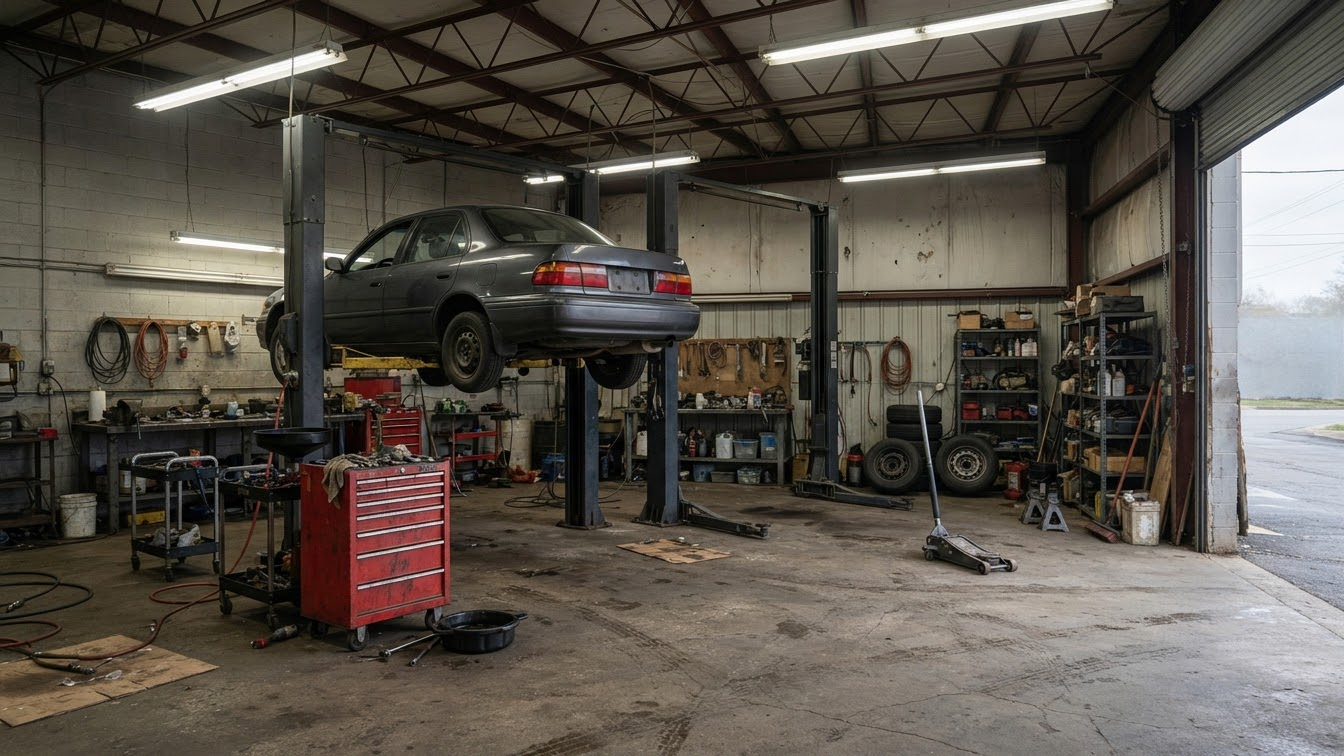
Quick answer
Tequi Consulting builds websites, online booking, Google Business Profile optimisation, review automation and customer follow-up for independent auto repair shops in Murrieta, Temecula, Menifee, Wildomar, Lake Elsinore, Hemet and Perris. Work is month to month with no contract, and we publish our pricing rather than quoting "marketing services".
The problem
Someone two miles away types "brake repair near me". If your Google profile is thin or your site is five years old, they call the shop on the next block instead. Nothing else on this page matters more.
You hear it, you cannot get to it, and they do not leave a message. They call the next shop. That customer is gone and you never knew they existed.
You told them in August the brakes needed doing. They said not today. Nobody followed up, so somebody else did them in November.
Happy customers almost never think to leave one. Unhappy ones always do. Unless you ask every single person, your rating is a survey of your worst days.
What the numbers say
of shops have no website at all
have one untouched for a year or more
pick a shop within 30 minutes of home
That third number is the whole argument. The person deciding right now lives near you. Auto repair also converts better from search than almost any trade we looked at — roughly one lead in six becomes a booking.
Shop figures: 2026 Ratchet+Wrench Industry Survey, 430+ shop owners, published June 2026. Lead cost and conversion: LocaliQ Search Advertising Benchmarks, Auto Service & Repair, 1,983 campaigns, April 2025 – June 2026. Distance figure: Consumer Reports, cited in the same survey.
How buyers decide
Almost nobody shops around on price for a repair. They are deciding who to trust with something expensive that they do not understand, usually while mildly stressed.
The list is drawn before anything else is considered: whoever is close, open, and visible on the map. Everything below only matters once you are on that list.
Not just the star rating — the recent ones, and whether the owner replied to the bad one like a reasonable person.
A car problem is urgent. If the call rings out they call the next shop, and they do not call you back.
Not cheap. Explainable. A shop that says what it will cost and why beats a shop that is vague and slightly cheaper.
European, diesel, hybrid, fleet. These searches are much smaller and much easier to win.
Demand
These fall into groups that want completely different pages. A price-led search and an urgent search are not the same visitor and should not land on the same words.
Work it out yourself
A missed call is not a lost call unless nobody follows it up. Put your own numbers in and see what the calls that ring out are plausibly costing you each month.
How this is calculated. Missed calls a month = calls per week × 52 ÷ 12 × the share that ring out. Revenue they represent = missed calls × average job value × the share you win when you do speak. The recovery range assumes an automatic text back brings back 20% to 35% of people who would otherwise have moved on — a reasonable band, not a promise, and the right half of it depends on how fast you reply to the reply.
About the starting numbers. These defaults are plausible starting points for a small independent shop, not figures we measured. Replace every one of them with yours — the estimate is only worth anything if the inputs are your own.
Plan ahead
Demand for auto repair shop work is not flat, and the marketing that works in July is not the marketing that works in January. Peak is typically Jul; the quietest stretch is around Jan.
Post-holiday slowdown. Good month to fix the website rather than advertise into a quiet market.
Pre-summer rush: A/C work, cooling systems, holiday trip checks.
Peak. Heat-related failures, overheating, batteries dying in high temperatures.
Quiet, and customers defer anything that is not urgent.
Illustration, not a measurement. A general pattern for inland Southern California, not a measurement of your shop. Use it as a prompt for what to plan ahead of, then check it against your own numbers.
Rules and compliance
California regulates this trade more tightly than most, and the marketing has to match.
Every shop is registered with the Bureau of Automotive Repair, and the register is searchable by anyone. Your licence status is a fact a customer can check, so the site should state it plainly rather than skirt around it.
California requires a written estimate and authorisation before work starts. "Free estimates" is not a marketing differentiator here — it is the law, and claiming it as a perk reads badly to anyone who knows that.
Asking only your happy customers for reviews breaks Google policy and FTC rules. Plenty of companies do it quietly. We ask everyone, which is slower and also the only version that survives contact with an audit.
If the site says 24 months/24,000 miles, that has to be the actual warranty you honour. This is the single easiest way for a shop to generate a complaint it did not need.
Where to start
For most shops this is where more customers arrive than the site. Categories, hours, services, real photos of the actual shop, and answers in the Q&A section. It costs nothing and it moves first.
Count the missed calls on one normal week. Multiply by what an average job is worth. That number is usually larger than everything else on this page combined, and the fix is an automatic text back.
Not the happy ones. Every one. Consistency is what makes the rating climb and stay climbed.
What you get
The services you want more of get their own pages. The ones you are tired of do not. Fast on a phone, because that is where it gets read.
They pick a slot on your site and it lands in your Google Calendar. No app for you to learn.
Categories, services, hours, real photos, Q&A, and a post every month.
Every customer, no filtering, no gating.
The call rings out and thirty seconds later they get a text. The highest-return item on this list for a shop.
The brakes you flagged in August come back as a text in November, timed to the service interval.
Questions
No. Nothing about your phones changes. The optional tracking number forwards to whatever you already use — a hardline, a VoIP box, your mobile. Your existing number keeps working for every customer who already has it.
The Google profile and review work matter just as much, arguably more, because you are competing against chains with budgets. The follow-up automation matters less when you personally know every customer. We would tell you to start with Core and skip the rest.
Then the highest-value thing we do for you is probably not lead generation at all — it is making sure the people already referred to you can find you, see your hours, and book without calling. That is a smaller job and we would price it that way.
It can be, done badly. A text every week is harassment. One text timed to when the service is actually due reads as useful. We set the interval with you and the customer can stop it with one word.
No, and anyone who does is lying to you. Google does not sell positions and does not take requests. What we can commit to is the work: the profile done properly, the pages written, the reviews coming in consistently.
How the whole thing fits together
Each of these is a place work leaks out. Most local businesses have three or four of them open at once, which is why the fix is never just "a new website".
Someone nearby types what they need. If your Google profile is thin or your site is slow on a phone, the search ends at a competitor and you never knew it happened.
They reach your site. They are deciding in a few seconds whether you look like a real business that will answer the phone.
A call, a form, a text or a booking. Every extra step here costs you a percentage of them.
This is the leak nobody measures. A call that rings out is usually a customer gone to the next listing.
A time lands in your calendar rather than in a voicemail you return tomorrow.
Reminders, declined work that comes back round, and a review request after the job. The cheapest customer is the one you already have.
No surprises
No part of this is quoted as "marketing services" and left vague.
One monthly figure, and a deposit before the build that is credited against your first month rather than added to it.
Listed line by line on the pricing section, not described as a package tier.
Ad spend is yours and goes straight to Google or Meta — we do not mark it up or take a percentage. Carrier fees for texting are passed through at cost.
The domain, the content and the customer data. All of it, whether you stay or not.
Straight comparison
This is the honest version, including the parts that do not flatter us.
| Tequi Consulting | The long-contract model | |
|---|---|---|
| Contract | Month to month. Leave any month, no termination fee. | Commonly twelve months signed up front, sometimes with a fee to leave early. |
| What you commit to | A deposit before the build that is credited against your first month, then month to month. | A deposit on top of the fee, and commonly twelve months signed up front. |
| Who you talk to | The person doing the work. | An account manager who relays it to the person doing the work. |
| Who owns the site | You do. The domain stays yours and the content comes with you. | Often built on a platform you cannot take with you. |
| Size | Small. One person on your account, which means fast answers and a real limit on how many clients we take. | Bigger, with more hands and more process. |
| Reporting | One page you can actually read. | A long dashboard export. |
The last two cut both ways, and we would rather say so: a bigger agency has more capacity and can absorb someone being on holiday. If you want a large team, we are not it.
Plain English
The business listing that appears in Google Maps and in the local pack at the top of search results. For most local businesses it brings in more customers than the website does.
The block of three map results Google shows above the normal blue links. Ranking here is a different job from ranking in the regular results.
How long it takes you to respond to a new enquiry. It decays fast: the same lead is worth noticeably less an hour later than it is in the first few minutes.
An automatic text sent when a call rings out, asking what the person needed. It turns a lost call into a conversation.
The registration US carriers require before a business can send automated texts. It takes a few weeks and there is no way around it — anyone promising you instant texting is either already registered or about to get filtered.
Writing pages so an AI assistant can quote them accurately when someone asks it a question. In practice it means clear questions, direct answers, and sources.
The share of visitors who do the thing you wanted. A site with fewer visitors and a better conversion rate often books more work.
Organic is search traffic you did not pay per click for. Paid is advertising. Organic is slower and compounds; paid stops the day you stop paying.
Related
Start here
One field is required — the rest you can skip. We come back with what we would build, what it costs and what you can leave out.
✓
We will take a look and come back with something you can actually click. If you left a way to reach you we will use it; if not, keep an eye out.